

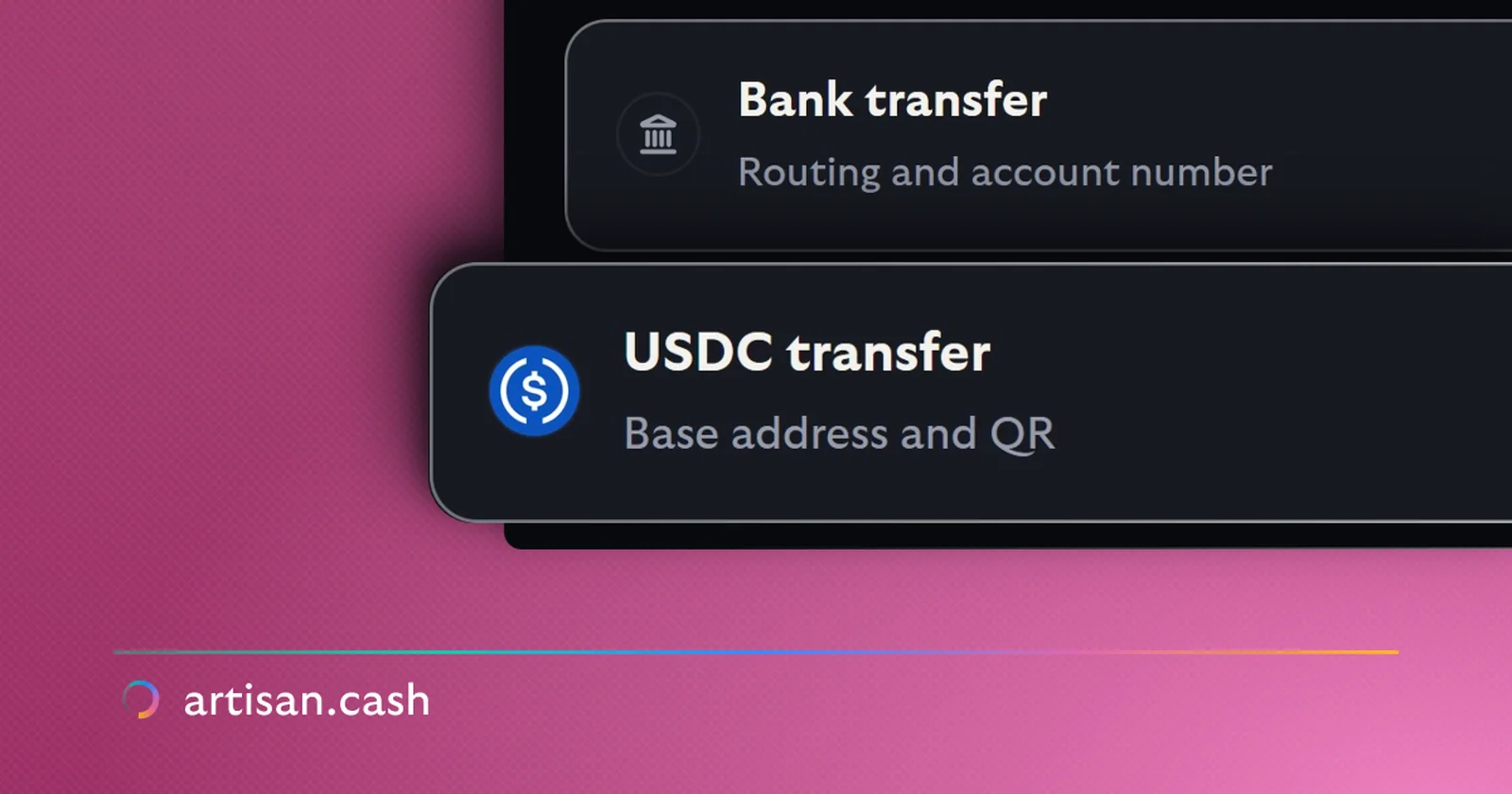
Three ways to take crypto
Should you accept crypto at all?
Count the invoices in the last six months where a client offered to pay in crypto. If none did, you can skip it for now. If some did, pick one of the three ways below and run one small test payment before you tell clients you take it.
How does a processor that converts the payment work?
A processor sits between your client and you: your client pays in crypto, the processor converts the payment into the currency you choose, such as dollars, and pays you on a schedule that your contract sets. A 2023 guide from the U.S. Chamber of Commerce calls this a gateway and describes a wallet as the other option, where you hold the crypto yourself.
Once the payment is converted, a later price move in the coin should no longer change what the service owes you. The guide says the service charges a fee, which varies by provider, so read the fee schedule carefully before you sign anything.
How does a wallet address you share work?
With a wallet address, you create a wallet, copy its address and put it on your invoice, and your client sends from their own wallet. No one else handles refunds, mistakes or support, so each one lands on you.
You must keep the key safe and tell the client which network to use, because you can only receive on networks your wallet supports, and money sent on an unsupported one may never arrive. If you lose the key to a wallet you hold yourself, there may be no way to get it back. Whatever you receive stays in crypto until you sell it.
How does a payment link work?
A payment link is a web address, often paired with a QR code, for one invoice or for your whole business, and your client opens it and picks a way to pay. Depending on the service, the choices can include a card or a bank transfer as well as crypto, which helps a client who holds none.
Links suit freelancers, creators and one-off jobs. Before you pick a service, ask what you will receive, whether dollars or a stablecoin, and what the service charges for each payment.
What it looks like in practice
Stablecoin or a coin that swings?
If the price of a coin moves between the invoice and the sale, you are paid more or less than you billed. A stablecoin is built to stay level with the US dollar, so you are paid close to what you billed. Ask for a stablecoin on a network that you and your client both use, and treat each unit as worth about one dollar, not exactly one.
What does a $1,000 job look like each way?
Made-up numbers, not a forecast: one $1,000 job.
| Way you are paid | You receive | After a $10 step out of crypto |
|---|---|---|
| A coin that swings | $900 after a drop of a tenth, $1,100 after a rise | $890, or $1,090 after a rise |
| A stablecoin | $1,000 | $990 |
| A processor, or a link that pays in dollars | About $1,000 minus what the service takes | None in this example |
The coin case: your client sends 0.02 of a coin at $50,000 a coin. By Friday it is down a tenth, to $45,000, so it sells for $900. The stablecoin case: your client sends 1,000 units of a dollar stablecoin, worth $1,000 here. The $10 step is an invented figure for both crypto cases, and the drop never touches you with a processor or a dollar link.
When something goes wrong
How do refunds work?
A card payer has legal protections and a dispute process with the card issuer. A crypto payer usually has only you. FTC guidance on crypto scams dated May 2022 says that crypto payments typically are not reversible, and that you can usually only get your money back if the person you paid sends it back.
For you, that means a refund is a new payment that you send, to an address your client gives you, on a network you both name. Write the rules down before the job starts: refund in the same coin or in dollars, who pays the network fee, and what happens if the price has moved.
What about disputes and chargebacks?
A client usually cannot pull back a crypto payment, so a chargeback is unlikely. That protects you from one type of loss. It also means your client has no card company to turn to, so questions come straight to you.
A client who pays with a credit card can dispute a billing mistake, such as a wrong amount or something that was not delivered as agreed, and FTC guidance on disputing credit card charges dated May 2022 says a written dispute must reach the card issuer within 60 days of the first bill that shows the mistake.
Can a bank payment be disputed?
It can be, if the customer says it was not authorized: they can ask their own bank to investigate, and the rule sets time limits. The CFPB rule called Regulation E applies to electronic transfers that debit or credit the account of a consumer, and a transfer sent through ACH is one of them.
A consumer who reports an unauthorized transfer within 60 days of the statement may get a temporary credit from their own bank while it investigates. The rule defines a consumer as a natural person, so it may not cover a client who pays from a business account. If you take business bank payments, ask whoever collects them what happens in a dispute before you ship.
Where Artisan fits
Where does Artisan fit?
An Artisan pay link can take debit card, credit card, bank payment, Apple Pay, Google Pay, Cash App, or crypto on over 50 chains (networks), and every payment lands in one Artisan account as USDC. The setup guide adds that “Your page draws only the ways that work for your account.” Card and bank payers may keep the dispute rights above, so such a payment may be challenged after it arrives, while crypto is usually final.
Artisan is a software company, not a bank. Its page where your money is says, “Your money sits in a self-custodial wallet that belongs to you,” and “we cannot recover a lost key for you.” Read it and the risk disclosures first.
What should you check before your first payment?
- Put an invoice number and the dollar amount on the invoice, with the coin and network you will take, so every payment can be matched to it.
- For each payment, record the date, coin, network, amount in coins and the invoice it paid, so you can answer a client who asks about it.
- Run a small test payment before the first real one.